women. don’t underestimate us.

It’s time to dig into another book of the Bible to study, and I’m feeling pulled to Exodus. I look forward to hearing God’s voice as I turn to one of my favorite books in the Old Testament.

The book opens with the Israelites being fruitful and multiplying, which becomes a threat to the new King of Egypt. I would love to stop here and make the correlation between the Israelites, God’s people, and the Church, also God’s people. I’d love to talk about the threat we become to the enemy when we are “being fruitful and multiplying” (and I’m referring to evangelizing…bringing people to Christ. Just so we’re clear about that). But I can’t stop here. God is speaking something else to me, so I have to keep moving.

So the king begins to oppress the Israelites by putting slavemasters over them, but the more they were oppressed, the more they multiplied and the bigger threat they became. What was the king so afraid of?

Come, we must deal shrewdly with them or they will become even more numerous and, if war breaks out, will join our enemies, fight against us and leave the country.” Exodus 1:10

 So the king took drastic measures. He ordered the Hebrew midwives to begin killing any male babies born to the Israelites, which the midwives did not do. So he gave the charge to his own people.

  Then Pharaoh gave this order to all his people: ‘Every boy that is born you must throw into the Nile, but let every girl live.’”  Exodus 1:22

Why the boys and not the girls? From the oppressor’s perspective, it makes complete sense. Boys become men. Men are warriors, created and built to fight for what is theirs. They are fierce, competitive, strong and brave, created to lead. With this in mind, it is understandable why the king of Egypt wanted to rid himself of the males of the people he was oppressing.

But while this king understood men, he greatly underestimated women. Many people do.

When Moses’ mother gave birth to him, she managed to hide the fact that a male had  been born for 3 months. When she could hide it no longer, she made a basket, put him in it and put him in the reeds along the Nile river. Pharoh’s daughter bathed in the Nile, and found the baby in the basket.

And here is where I begin to smile.

Moses’ sister had been watching to see what would happened to the baby. When Pharaoh’s daughter found him, she knew he was “one of the Hebrew  babies” (2:6). So, the sister asked her if she should go find a Hebrew woman to nurse the baby. You can see the plan coming together now. Of course, she went and found the baby’s mother and brought her to Pharaoh’s daughter, who then told her “Take this baby and nurse him for me, and I will pay you.” (2:9)

Not only did this Hebrew woman save her male baby from the clutches of Pharaoh and his evil decree, but she ended up being commanded to nurse the baby (which probably would have lasted around 2 years), and was paid for it! By Pharaoh! After she finished nursing him, she gave him back to the Pharaoh’s daughter, and he was raised in Pharaoh’s household. Because of these women, Moses was spared the fate of so many other Hebrew babies.

Women. Fiercly protective of their children. Resourceful and intelligent. Quietly dangerous to the schemes of evil.

Pharaoh feared what the Israelite men could do, and rightly so. His fear should have been bigger than that.

As we know, Moses grew up and became the man who would be used by God to make the Pharaoh’s biggest fear a reality. He would lead God’s people out of Egypt.

A lesson for the enemy…Fear God’s men, but never underestimate the threat of His women.

He’s looking for a weakness

Sometimes, it’s all just a matter of perspective. Sometimes. But not always.

In Exodus 4:10, Moses was trying to convince God that He had the wrong man for the job of convincing Pharoah to let the Israelites go.

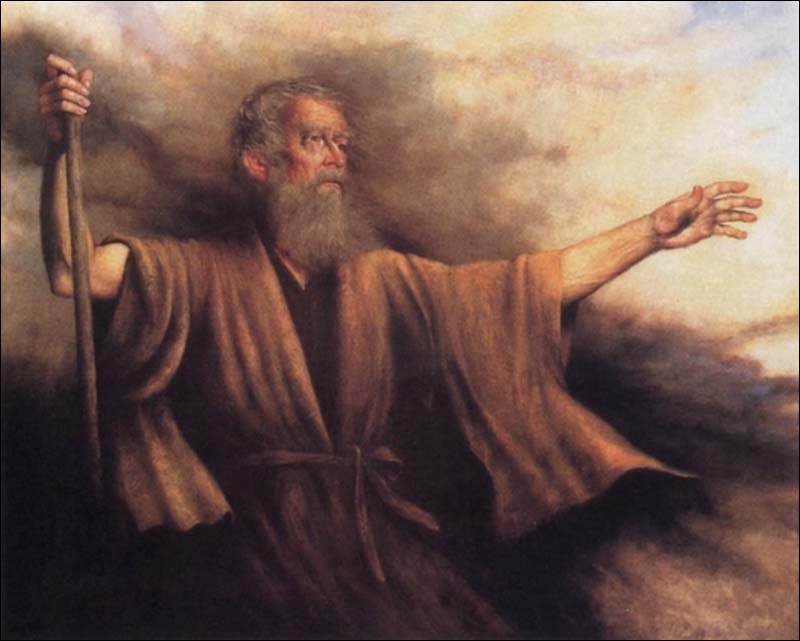
moses_blessing_zoom“Moses said to the LORD, ‘O Lord, I have never been eloquent, neither in the past nor since you have spoken to your servant. I am slow of speech and tongue.’”

Moses knew his weakness. He knew he was quite ill-equipped to be God’s spokesperson to the ruler of Egypt.  He may have been good at many other things, but wouldn’t you know it…the one thing he can’t do is the very thing God assigns to him.  And bless his heart, he really tried to get out of it. “But Moses said, ‘O Lord, please send someone else to do it.'” (v. 13)

I can hear the fear in Moses’ voice, and to my ears it’s bordering on panic. He just knows that he cannot do what God has called him to do.  He knows his weakness and his limitations, and they do not fit the job description. What Moses apparently did not know, was the power of God, and what would be said of Moses many generations later.

“The LORD said to him, ‘Who gave man his mouth? Who makes him deaf or mute? Who gives him sight or makes him blind? Is it not I, the LORD?  Now go; I will help you speak and will teach you what to say.’” (v. 11-12)

Here is what I hear God say to me in this ~ “I know you are weak. I am the One who created you, and your weakness. Obey My call anyway, and I will enable you to do what your weakness prevents.”

When we try to help people learn what their calling from God may be, what their place in the Body is, we often ask them “What are your strengths and weaknesses?” Then we focus on their strengths, because for some reason we think that’s God’s focus. It isn’t. It never has been.

“Brothers, think of what you were when you were called. Not many of you were wise by human standards; not many were influential; not many were of noble birth. But God chose the foolish things of the world to shame the wise; God chose the weak things of the world to shame the strong.” 1Corinthians 1:26-27

God uses our weakness far more than He uses our strength.  Our weakness keeps us close to Him, causes us to depend on Him. But mostly, our weakness causes God and His strength to be evident. It is His glory revealed when we do what we are called to do in our weakness. Our strength does the opposite.

Moses knew his weakness. God said “I will help you”. Generations later, listen to how Stephen describes Moses.

“Moses was educated in all the wisdom of the Egyptians and was powerful in speech and action.” Acts 7:22

Perspective? Or is it what a weakness becomes in the hand of God?