who has heard?

“I know that the Lord has given you this land and that the terror of you has fallen on us, and everyone who lives in the land is panicking because of you. For we have heard how the Lord dried up the waters of the Red Sea before you when you came out of Egypt, and what you did to Sihon and Og, the two Amorite kings you completely destroyed across the Jordan. When we heard this, we lost heart, and everyone’s courage failed because of you, for the Lord your God is God in heaven above and on earth below.” – Joshua 2:10-11

Do you know who hears about that time God made $600 appear in our bank account? Or the day I had a horrible toothache and He told me to lay hands on my jaw and command healing to come, and it came? Or any of the many times God has been spectacularly evident for me?

Believers. Other Christians that are like-minded, who worship like me, believe like me, use the same lingo I use. That’s who hears about the exploits of God in my life. Know why? Because they won’t think I’m weird. They won’t look at me like I just grew another head. They won’t walk away thinking I’m “one of those people”, and try to figure out how to avoid lengthy conversations with me in the future.

So God is dealing with me right here in Joshua’s story. Dealing with my need for people, both believers and unbelievers, to approve of my walk with God. At the same time, He is showing me the bigger picture (because there is always a picture that is bigger than me and my life) of the Church.

So let’s talk about that. It’s much more interesting than the angst I am dealing with on a personal level as God exposes motives and various items of junk in my heart.

“I know that the Lord has given you this land and that the terror of you has fallen on us, and everyone who lives in the land is panicking because of you.” (v. 9)

You know those toys, the things that show you one picture if you hold it a certain way, but if you shift your hand just slightly, a different picture appears? Let’s do that with this passage.

If we hold it one way, we see the real story taking place of two spies and a prostitute having a conversation. But let’s shift our hand ever so slightly.

Now we see the spiritual picture of God’s people and the enemy (satan and his demons). We see the realm that we miss if we don’t think to look past the natural.

The Church’s mission is to expand the Kingdom of God, not just by moving into more and more territory, but by coming into a territory and making disciples there. Since the Kingdom of God is wherever the power and authority of God are ruling and reigning, when people come to salvation, they are now a place where that is happening. The more people that have the power and authority of God in them through the Holy Spirit, the larger the Kingdom of God becomes. Make sense?

So if we see the story here from that place, then Rahab’s comments are very revealing. They tell us that the (spiritual) rulers of any territory that we are about to head into are panicking, and terror has fallen upon them. Because they know. They’ve heard of God’s power in His Church. They know that our God is Lord of heaven and earth.

But do we know it? Are we aware that there are territories waiting for the Church to come in and conquer the darkness there? Do we understand who we are, what we have been commanded, and Who is with us in it?

Or are we still looking at the picture in the physical and getting overwhelmed by what we see?

If the Church is going to be strong and courageous, then it has to start with me (and you). I have to understand that when I declare the power of God in my life, telling of the seas He has parted and the mountains He has moved, I’m not just talking to the people in front of me. I’m declaring that my God is Lord of heaven AND earth to the darkness that is over the territory I’m in. And while the people in front of me may roll their eyes and think I’m weird, I know that the enemy begins to panic.

He panics because strong and courageous just entered his territory. And there can only be one reason she’s here.

So tell me, who has heard of your God? Not just the God who hates homosexuality or public schools or Democrats. That, honestly, does not make the enemy tremble, or people want to know Him.

Who has heard of the God who forgave your sin, who freed you from bondage, who healed your sickness, who provided for you when there was nothing left? The God who made a way when there wasn’t a way for you, who brought you through the fire unharmed? Who has heard about the God who changed you, who took you from darkness to light, from death to life?

Who has heard?

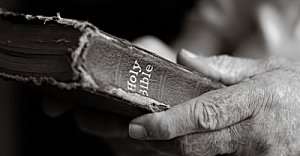
why christians aren’t reading the bible

{Disclaimer:  Everything I’ve written below pertains to those who claim to follow Christ.}

After taking a poll, and from my own experience, the top 3 reasons Christians give for not reading the Bible are:

  • I don’t understand what I’m reading.
  • I don’t have time.
  • It’s not relevant to our culture today.

They seem like reasonable excuses reasons, and if they weren’t life-threatening, I would let it go. But they are. They are life-threatening little lies that have been sown by the enemy of your soul. And you are the Church, so I love you and scripture is food that you need to stay alive. I can’t just ignore the fact that you are starving yourself to death, so I really want to try to convince you to eat.

– I don’t understand the Bible. It’s confusing to me. 

To be honest, I would be concerned if the Bible were an easy read. It is a complex book, with layers of meaning on every page, authored by a mysterious and complex God.  So we will read for all of our days and never fully get it. But as mysterious as He is, He does not hide from us in His Word. For the first 4 years after I came to Jesus, I had zero knowledge of God, and a Bible I didn’t understand.  But I wanted to know God. I needed to know His heart for me, and I believed I would find it in that book. So I read and read and read until little by little, understanding started to form. I also asked God to help me comprehend what I was reading, and He did, a little at a time. Twenty-nine year later, I’m still reading, still asking. But I understand a whole lot more than I did twenty-nine years ago.

There is no question that God wants us to know Him, and to know and comprehend His Word. I think the question begging for an answer is this:

How important is it to you that you know and understand the Word of God?

– I don’t have time.

It feels that way for all of us, but those feelings are not true. We can get up earlier, watch less television, put down our phones, get off of our computers, spend less time wasting time, and we’d have a lot of time on our hands. The issue is priorities, not time.  If you felt your body starving, food would be a priority, no matter what you had to give up in order to eat. But you don’t feel your spirit starving. You think the weekly sermon, maybe a podcast during the week or that five-minute devotional you have with your coffee is sufficient. That’s like trying to keep your body alive by eating nothing but biscuits. You’ll get no argument from me that biscuits are a mighty fine piece of food, but you cannot live on them.

Discipline is part of the priorities issue. I have the same problem, only with actual food. It’s easier to grab a quick bite of processed food than to take the effort and time to make a healthy meal (that makes us me lazy, not pressed for time). For years and years, we don’t see what our undisciplined lifestyle is doing to us, and then one day we find ourselves in a battle in which we are on the losing end. So I’ll ask you what I’ve had to ask myself:

How important is it to you to be healthy? 

– It’s not relevant to my life today. 

Yes. The names and the places are foreign to us, as are the cultures in which the word was written. I’ll give you all of that. But honestly, the Bible is so much more than names and places and cultural settings. It’s about people who cannot seem to grasp how deeply they are loved by God, so they wander around looking for love in all the wrong places. It’s about people who struggle to trust a God they can’t see, in spite of everything He’s done for them. It’s the story of fearful, weary, prideful, broken, unfaithful, strong-willed, weak-willed, sinful people trying to figure things out.  It’s about people who want to do good but keep returning to the mud hole again and again.  It’s about love and hate and hurt and truth and lies and fear and bravery. It’s about slavery and freedom, and how we can go from one to the other. It’s about hope. And it’s about the God who is the author of that hope, the giver of life, the healer of the broken, the giver of mercy, and the Savior of all who will believe Him, including you.

How can that not be relevant to you?

In many places, the Church is starving herself, or at best, subsisting on the sugary coated sermons of eager to please pastors and/or feel good devotionals. There are far too many of the people of God who do not know the word of God, which means they are ill-equipped to battle the lies that are ruling in the earth. I’ve encountered so many believers who live in fear, anxiety, and insecurity, and those same believers do not know, or have a very limited knowledge of, scripture. Coincidence, or principle?

But it’s more than just knowing what the bible says. I am convinced, more than ever before, that if we are to be people who know God, trust God, love God, and who are equipped to stand firm in the coming days, we must be a people who have the Word of God in us, and who believe that it’s true!

In my next post, I’m going to talk about what the Word of God has to say about the Word of God, and why it is imperative that we make it a priority in our lives as followers of Christ. Stay tuned!


the f-word

aphiemi is our f-word. It means to send away, dismiss, set free.  It means to forgive.

So much has been said about forgiveness so I won’t go on and on. Probably. Maybe. We’ll see.

Here is what I have seen, what I am seeing, and what I myself have done:  searched the scriptures for a way out of forgiving someone, rather than for a way into it. Usually, our way out lies in a lack of repentance, or change, on the part of the person we need to forgive.  Most often the door out of forgiving is found in Luke 17:3-4.

“If your brother sins, rebuke him, and if he repents, forgive him. And if he sins against you seven times in a day, and comes back to you seven times, saying, ‘I repent,’ you must forgive him.” 

Ergo, if they don’t repent, we don’t have to forgive them. Two other places used as a way out of forgiveness are Colossians 3:13: “Just as the Lord has forgiven you, so you must also forgive.” and Ephesians 3:32 – “And be kind and compassionate to one another, forgiving one another, just as God also forgave you in Christ.”

God’s forgiveness comes at our repentance, so we use repentance, or change, as our measuring stick of whether or not we have to forgive someone. So let’s just talk about that.

What if, in Luke 17, the point Jesus was making was not repentance, but forgiveness? What if He was addressing the heart of the forgiver, not the forgiven? What if He was saying “I don’t care how many times he does the same thing to you and keeps coming back and saying “sorry”…you cannot withhold forgiveness.”

I mean, what if someone coming back over and over again and repenting for the same sin isn’t really the definition of repentance, and therefore, repentance is not the criteria for forgiving someone seventy times seven?

So let’s throw Colossians and Ephesians up and see what sticks.

“Just as”. That’s what usually sticks. And so then we say God forgave us when we repented, so just as He did, we are to do. Ok, fair enough. Let’s talk about that.

What if we have no ability to offer anyone salvation and therefore, our forgiveness cannot be based on repentance? What if by “just as”, He was referring to any number of other things besides “when they repent”?

Like, completely. Fully. Unmerited. Forgiveness given when it is not even close to being deserved. Because that is how God has forgiven us in Christ, and it should make us out of our minds grateful. Not searching for a way not to give that same thing to others.

What if God was saying to us, “I so desired to forgive you that I sent my Son to die to make it happen”. What if forgiving as God forgave means looking for a way to forgive, rather than for a way not to forgive?

Well, what about repentance? What about it? First of all, those of us who are looking for a reason not to forgive, aren’t really looking for repentance. We want change. We are demanding to see the fruit of repentance before we forgive. Which is not the way that God has forgiven us. Not if we believe the gospel. What we really have to ask ourselves is not “did they repent”, but “what do we do with these scriptures”:

But if you don’t forgive people, your Father will not forgive your wrongdoing. – Matthew 6:15

And whenever you stand praying, if you have anything against anyone, forgive him, so that your Father in heaven will also forgive you your wrongdoing. – Mark 11:25

Shouldn’t those statements have us scrambling to find a way to forgive the people who have hurt us, rather than trying to find justification not to forgive them?

I know what it feels like to have to forgive someone who has done you great harm, and not owned up to it. I know how hard that is and how gut-wrenching the work of forgiveness can be.  I know that it feels like forgiveness is the same as saying they didn’t do what they did, or that what they did doesn’t matter. It feels like they are getting away with something. It feels unjust.

This has become one of the deepest truths I know:  forgiveness is a choice, not a feeling. If you are waiting to feel forgiving, stop it.  We have to stop trying to figure out what forgiveness feels like, and see what it looks like. Below is an excerpt from my book on the restoration of my marriage (the book is still in process):

It looks like never mentioning any of it ever again. No matter how mad I am. No matter how hurt I am. No matter how much I want to get back at him. I choose to let forgiven things remain forgiven.

It looks like not allowing my thoughts to turn over the rocks of the past, digging up the dirt of things buried in my forgiveness. In other words, I don’t think about the things I’ve forgiven. I just don’t. If those thoughts come in, I send them right back out. I choose to think of something else. I choose to start speaking Scripture about what is true about my husband. I choose to keep forgiving.

It looks like allowing my scars to be evidence of God’s healing instead of evidence of my wounding. Those scars didn’t all come from my husband. I had to forgive the person who molested me, the ex-husband who abused me, and [many others who have hurt me deeply throughout my life].

Forgiveness in my story looks like refusing to protect my own heart from pain. It’s staying vulnerable. It looks like trusting God.

It looks like remembering how very much I have been forgiven. It’s recognizing that what was done and what was said during those years were from a place of brokenness, and broken people do broken things and we are all broken at some point. You. Me. All of us have hurt people we love. Then we pull out our scales of justice and measure how much pain we’ve inflicted against how much pain we’ve been dealt and somehow, the scale always tips in our favor. I choose to throw away the scales of what justice looks like to me, because it is mercy and forgiveness I’ve been given by God, not justice.

If you are struggling with the f-word, then do what you know to do. Repent. Turn around. Go the other way. Look for a way into forgiveness instead of a way out of it.

I promised not to go on and on. Promise broken. Forgive me.

Holy Spirit, who are You?

In my quest to go deeper, to know the heart of God more, it was inevitable that I would find my way here. Because after almost 24 years of relationship, I still find the Holy Spirit to be a mystery. I’ve been taught much, heard much, and have even sensed His presence many times, and I still feel as though I need to stick out my hand, introduce myself and ask Him that question.

Just who are You, really?

I am filled with the urge to search, and I know of only one place to search for God; only one place that I know for sure He will be found.  And I remember that “In the beginning“, the Spirit of God was there, so that is where I turn. And I find the first glimpse of the Holy Spirit.

“Now the earth was formless and empty, darkness was over the surface of the deep,and the Spirit of God was hovering over the waters.” {Genesis 1:2}

Hovering. Rachaph is the Hebrew word. It means to brood, like a mother bird broods over her young.

It also means “to cherish”.

The exact same word is used in Deuteronomy 32:11, describing God’s care for Israel ~

“like an eagle that stirs up its nest
    and hovers over its young,
that spreads its wings to catch them
    and carries them on its pinions.”

He cherishes.

And I am reminded ~

“And hope does not disappoint us, because God has poured out his love into our hearts by the Holy Spirit, whom He has given us.” {Romans 5:5}

I sat back and closed my bible, closed my notebook and put down my pen. And then I chose to believe what I had found.

The Holy Spirit of God is not just a vaporous mystery. He’s not just power and strength, worker of signs and wonders, and Giver of gifts.

Suddenly the fact that I am indwelt by the Holy Spirit looks different to me.

“In the beginning…”  became “Here is the first thing I want to tell you about Myself. You are cherished by Me.”

Holy Spirit of God…

It’s so nice to meet You.

she did what she could

I cannot leave the gospel. My fingers flip pages and my eyes scan words and stories and always I am drawn back. I am searching for the heart of the One I love and He keeps bringing me back to the beginning. This is my journey. My story. Good news hammering against the rocks.

“Leave her alone,” said Jesus, and the hammer came down, making my breath catch.

“While He was in Bethany, reclining at the table in the home of a man known as Simon the Leper, a woman came with an alabaster jar of very expensive perfume, made of pure nard. She broke the jar and poured the perfume on His head.

Some of those present were saying indignantly to one another, “Why this waste of perfume? It could have been sold for more than a year’s wages and the money given to the poor.” And they rebuked her harshly.

Leave her alone,” said Jesus. “Why are you bothering her? She has done a beautiful thing to me. The poor you will always have with you, and you can help them any time you want. But you will not always have me.  She did what she could. (Mark 14:3-8)

She did what she could. And against the harshness of men, He rose up protective.

This is for you. For me. For all the ones who do what they can. For the ones who hear the harshness of

not enough

too much

you should have

you shouldn’t have

The ones who long to bring what they have and just pour it out over Him because we can do nothing else.

For those of us who will never feed five thousand, but spend the last five minutes of our weary day feeding on Him.

For those who will never lead thousands into the Kingdom, but will live face to the ground praying for the one.

For all the ones who will never do great and mighty things, but who choose to put one foot in front of the other to follow Him in a harsh world.

Broken hearts broken open, poured out

Broken prayers flowing like perfume

Fleeting, weary moments given to Him

Songs we refuse to let fear silence

He will protect it all. He will honor every bit of it.

This is the Heart I found today.