beautiful words

You will be with child and give birth to a son…“.

Suddenly, life was different than she thought it would be. Mary was blessed, highly favored, a virgin planning to be married, and live the life of a carpenter’s wife. She may have been dreaming of her wedding, perhaps even nervous about her wedding night. And in one moment, her small story gave way to a bigger story, as what had been possible gave way to what was impossible.

A virgin would give birth to God.

And from her came a most beautiful sound. “I am the Lord’s servant…May it be to me as you have said.”

doulos( The word is doulē – the feminine form of doulos.)

It is the sound of trust, of devotion, of one who does not count her life as her own. The sound of one who does not grip her own story, with all of its plans, hopes, and dreams. One who is willing to let her life bring forth God’s glory, no matter the cost.

It is the core of our Christianity, is it not? This impossible birthing of God from the womb of a virgin. Those of us who are followers of Christ do not question the truth of Mary’s story. What others celebrate once a year, we hold in our hearts every day.

Mary, blessed and favored by God. Chosen to carry Christ.

“To them God has chosen to make known among the Gentiles the glorious riches of this mystery, which is Christ in you, the hope of glory.”

We too are blessed, having been chosen to carry Christ in us. The living God, dwelling in the hearts of those who follow.

So why is it so hard for us, this doulos life?

Christ is in us. God is for us. What do we lack?

What keeps us gripping our own story, our own plans, with our arms wrapped around our cisterns that do not hold water?

Christ is in us and God is for us. What should we fear?

That life will not go as we had planned? That we will not be in control? That our small story is all we have and if we lose that what is left? Are we afraid that what God has said is really true…that are lives are no longer ours to have and to hold?

I pray for us. I pray for me. I pray that by the power of Christ in us and God for us, we will stop. Stop gripping and fearing and chasing down what is possible.

This Christmas we will once again declare our faith in the impossible. Let us not stop there.

Let us turn, with our hands emptied of our own story, and speak beautiful words to God.

“I am Your doulos…may it be to me as You have said.”

 May our lives birth glory as we lay them down.

Luke 1:31; Luke 1:38; Colossians 1:27; Romans 8:31;

doulos

Woke up with a massive migraine. Took painkillers left over from the car wreck. Woke up five hours later feeling hungover, but the tiny people were no longer using giant sledgehammers on my brain. Now they’re just rubber mallets. Much better. Opened my bible, thinking Psalms, or maybe Song of Songs. Something soothing.

Instead I went to James. I’m as surprised as anyone. Who reads James when they don’t feel good? I don’t know, because I didn’t actually read James. I read the first sentence and then tripped.

doulos“James, a servant of God and of the Lord Jesus Christ”…

I think his opening words meant much more to James and the first readers of his letter, than to us. In fact, I bet most of us just skim over those words,  because who pays attention to introductions? The writer is simply identifying himself.

James was the brother of Jesus, and at first did not believe his brother was the Messiah and openly opposed Him. But James eventually became a believer, and very well known in the Church. He was the leader of the church in Jerusalem, and a “pillar” of the Church, according to Paul. James could have identified himself using any number of words. Personally, I think most of us would have pulled out the “brother of Jesus” card for sure.

Who are you, James? “a servant of God and of the Lord Jesus Christ”.

What comes to mind when you hear the word ‘servant’? I think of foot washing. I think of someone who does the menial tasks, the one who sets up the tables for a church event. I think of terms we use, such as “servant-leadership”, and “he has a servant’s heart”, and how those terms generally refer to “doing”. I have even said “I am a servant of Christ” myself, usually under my breath while I am doing something no one else would volunteer for. And in my best martyr’s voice.

In the Greek language, there are various words used for our one word “servant”, and they have different meanings and shades of meaning. To fit my definition above (minus the martyr’s voice), the word James would probably have had to use is ‘diakonos’:

~ one who executes the commands of another, especially of a master ~ the servant of a king ~ a deacon, one who, by virtue of the office assigned to him by the church, cares for the poor and has charge of and distributes the money collected for their use ~ a waiter, one who serves food and drink.

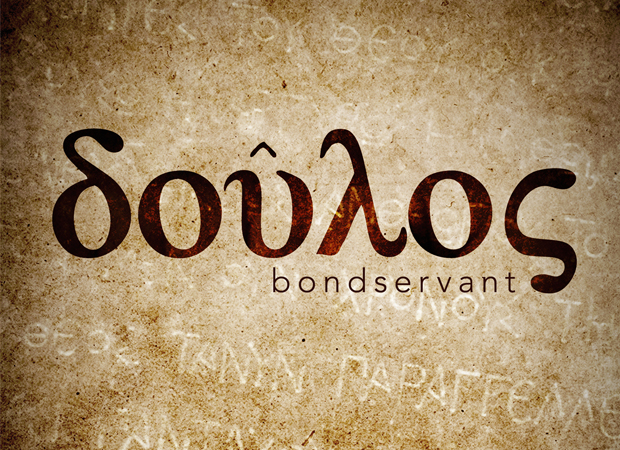
But the word he actually used to identify himself is “doulos”, or “bondservant”:

~ slave ~ one who gives himself wholly to another’s will ~ one who is devoted to another to the disregard of one’s own interests ~ those who’s service is used by Christ in extending and advancing His cause among men  ~ all who obey God’s commands; His true worshippers

Big difference. James identified himself not as someone who did things for God, but as someone who had willingly enslaved and bound himself to God. He was completely and utterly devoted to God and to Jesus, laying down his own will and interests. A bondservant is one who is completely given over to the one he serves. It is a position that expresses the absolute highest devotion.

It is no small thing to be a doulos of Christ. It is not something we can use to guilt convince people to volunteer to do more in the church.

dig deepThis kind of study and digging fascinates me, and I could literally spend hours and hours doing it. But my desire to go deeper, and to know the heart of God more, won’t be satisfied by a word study, unless it results in revelation from the Holy Spirit. It was when I was reading my study notes about the life of James that I got the revelation that took me deeper.

James was martyred in 62 A.D.  Not because he was a diakonos, but because he was a doulos

James, Paul, Peter, and Jude all identified themselves as bondservants (doulos) of Christ. In their letters to the churches, they give a very vivid picture of what the life, and the faith, of a bondservant looks like. They were obedient, crucified lives. These men weren’t spiritual super heros. They were filled with the Spirit of God, but they were mortal men who had made a choice, a decision to live life, all of life, for God and for the cause of Christ.

Everyone of them were killed for that decision.

How do I want to be identified? diakonos, or doulos? One can make me feel like a martyr, the other, given the right place and time, could actually make me one.

I probably should have gone to the Song of Songs. James wasn’t good for my headache.