the f-word

aphiemi is our f-word. It means to send away, dismiss, set free.  It means to forgive.

So much has been said about forgiveness so I won’t go on and on. Probably. Maybe. We’ll see.

Here is what I have seen, what I am seeing, and what I myself have done:  searched the scriptures for a way out of forgiving someone, rather than for a way into it. Usually, our way out lies in a lack of repentance, or change, on the part of the person we need to forgive.  Most often the door out of forgiving is found in Luke 17:3-4.

“If your brother sins, rebuke him, and if he repents, forgive him. And if he sins against you seven times in a day, and comes back to you seven times, saying, ‘I repent,’ you must forgive him.” 

Ergo, if they don’t repent, we don’t have to forgive them. Two other places used as a way out of forgiveness are Colossians 3:13: “Just as the Lord has forgiven you, so you must also forgive.” and Ephesians 3:32 – “And be kind and compassionate to one another, forgiving one another, just as God also forgave you in Christ.”

God’s forgiveness comes at our repentance, so we use repentance, or change, as our measuring stick of whether or not we have to forgive someone. So let’s just talk about that.

What if, in Luke 17, the point Jesus was making was not repentance, but forgiveness? What if He was addressing the heart of the forgiver, not the forgiven? What if He was saying “I don’t care how many times he does the same thing to you and keeps coming back and saying “sorry”…you cannot withhold forgiveness.”

I mean, what if someone coming back over and over again and repenting for the same sin isn’t really the definition of repentance, and therefore, repentance is not the criteria for forgiving someone seventy times seven?

So let’s throw Colossians and Ephesians up and see what sticks.

“Just as”. That’s what usually sticks. And so then we say God forgave us when we repented, so just as He did, we are to do. Ok, fair enough. Let’s talk about that.

What if we have no ability to offer anyone salvation and therefore, our forgiveness cannot be based on repentance? What if by “just as”, He was referring to any number of other things besides “when they repent”?

Like, completely. Fully. Unmerited. Forgiveness given when it is not even close to being deserved. Because that is how God has forgiven us in Christ, and it should make us out of our minds grateful. Not searching for a way not to give that same thing to others.

What if God was saying to us, “I so desired to forgive you that I sent my Son to die to make it happen”. What if forgiving as God forgave means looking for a way to forgive, rather than for a way not to forgive?

Well, what about repentance? What about it? First of all, those of us who are looking for a reason not to forgive, aren’t really looking for repentance. We want change. We are demanding to see the fruit of repentance before we forgive. Which is not the way that God has forgiven us. Not if we believe the gospel. What we really have to ask ourselves is not “did they repent”, but “what do we do with these scriptures”:

But if you don’t forgive people, your Father will not forgive your wrongdoing. – Matthew 6:15

And whenever you stand praying, if you have anything against anyone, forgive him, so that your Father in heaven will also forgive you your wrongdoing. – Mark 11:25

Shouldn’t those statements have us scrambling to find a way to forgive the people who have hurt us, rather than trying to find justification not to forgive them?

I know what it feels like to have to forgive someone who has done you great harm, and not owned up to it. I know how hard that is and how gut-wrenching the work of forgiveness can be.  I know that it feels like forgiveness is the same as saying they didn’t do what they did, or that what they did doesn’t matter. It feels like they are getting away with something. It feels unjust.

This has become one of the deepest truths I know:  forgiveness is a choice, not a feeling. If you are waiting to feel forgiving, stop it.  We have to stop trying to figure out what forgiveness feels like, and see what it looks like. Below is an excerpt from my book on the restoration of my marriage (the book is still in process):

It looks like never mentioning any of it ever again. No matter how mad I am. No matter how hurt I am. No matter how much I want to get back at him. I choose to let forgiven things remain forgiven.

It looks like not allowing my thoughts to turn over the rocks of the past, digging up the dirt of things buried in my forgiveness. In other words, I don’t think about the things I’ve forgiven. I just don’t. If those thoughts come in, I send them right back out. I choose to think of something else. I choose to start speaking Scripture about what is true about my husband. I choose to keep forgiving.

It looks like allowing my scars to be evidence of God’s healing instead of evidence of my wounding. Those scars didn’t all come from my husband. I had to forgive the person who molested me, the ex-husband who abused me, and [many others who have hurt me deeply throughout my life].

Forgiveness in my story looks like refusing to protect my own heart from pain. It’s staying vulnerable. It looks like trusting God.

It looks like remembering how very much I have been forgiven. It’s recognizing that what was done and what was said during those years were from a place of brokenness, and broken people do broken things and we are all broken at some point. You. Me. All of us have hurt people we love. Then we pull out our scales of justice and measure how much pain we’ve inflicted against how much pain we’ve been dealt and somehow, the scale always tips in our favor. I choose to throw away the scales of what justice looks like to me, because it is mercy and forgiveness I’ve been given by God, not justice.

If you are struggling with the f-word, then do what you know to do. Repent. Turn around. Go the other way. Look for a way into forgiveness instead of a way out of it.

I promised not to go on and on. Promise broken. Forgive me.

broken and whole

She showed me her little clay pot that was a lovely shade of blue. I was surprised at how beautiful it was. Beautiful and cracked. Broken and whole. Jagged lines ran up and down and sideways all over it. It wasn’t hard to figure out what had happened.

blue pot

Because when something has been broken and put back together…it shows. 

It was therapeutic for her. She took the pot and smashed it and it helped something inside of her. And then she found the pieces and glued them back together and that helped too. Sometimes, we need to see something broken and put back together to really believe there is hope, you know? Hope that we can be put back together. Hope that even though our brokenness shows, we are still beautiful.

I saw the clay pot with jagged lines and I thought of my own jagged lines and I know God’s voice and He spoke that day.

 ‘Light shines best through vessels that have been broken.’

Trying to live this life on our own terms doing it our own way living far from God breaks our lives and our hearts and our very souls. And the prayer is that the breaking will lead to broken.

                              Because repentance is brokenness and it turns us from what is breaking us.

Brokenness is clinging to Jesus because we’ve discovered our greatest need is Him. Brokenness praises Him through pain and things we don’t understand because we know that no matter what He is God and He is good. Brokenness raises hands in surrender not fists in defiance and finally drinks in the grace that puts us back together with jagged lines.

And broken vessels are always amazed by the grace that makes them whole.

broken pot

Life can break us hard but grace leaves us sweetly broken and grace makes us whole. I’ve had the breaking and I’ve been broken and I want to see beauty, not shame, in my jagged lines. I want light to dance from these places put back together by grace. Places where the light shines best.

desperate encounters – pt. 3

This is part 3 of a 4 part post in which I look at four women, desperate for different reasons, who encountered Jesus. In part 1 I highlighted the woman at the well. You can read that here.  Then we looked at the woman with the issue of blood in part 2. Today I want to get to know one of my favorites. Actually, they are all my faves, but today’s desperate woman just speaks to me.

From Luke 7:36-48

The Sinful Woman

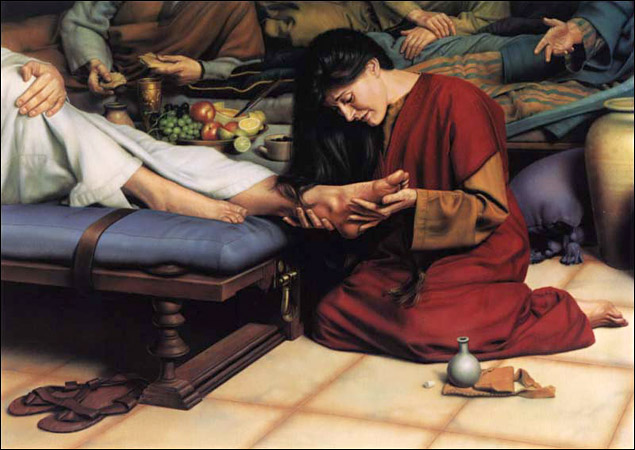
To be invited to a Pharisee’s home for dinner was not a small thing. It meant you were “somebody”. To have the lastest teacher or prophet at your home was an honor. No doubt Jesus’ popularity meant Simon the Pharisee wanted to be seen with Him. Given the fact that the Pharisees were always trying to trip Jesus up, this dinner party could also have been an opportunity to publicly embarrass Him. We really don’t know. What we do know, is that Simon did not extend customary hospitality to his esteemed guest, so I’m leaning toward Simon’s motives being a little shady here. Nevertheless, Jesus reclined at Simon’s table. Dinner would have been eaten around a very low table, and Jesus would have been reclining on one arm, supported by divans or cushions.  His feet, sandals removed, would be stretched out behind Him. And to those sinless feet, a sinful woman would come to worship.

sinful womanThink about her life:  No husband, alone, no way to support herself, known all over town as “a sinful woman”, which most likely meant she was a prostitute. Her prospects did not look good. Few men would marry such a woman. She would have been shunned by respectable society and prohibited from participation in the local synagogue.

She was unclean, unwanted, unacceptable, uninvited and unwelcome. So she came to Jesus with nothing but her desperation and an alabaster jar. And with these, she made a public display of repentance and worship. She pushed past the scorn of those around her, and she worshipped the One who could forgive her sin.

                             Our desperation can take us into many places before we finally let it drive us to the feet of Jesus.

“When the Pharisee who had invited him saw this, he said to himself, ‘If this man were a prophet, he would know who is touching him and what kind of woman she is — that she is a sinner.'”

But He did know. And when He was finished with Simon, the Pharisee also knew what kind of woman she was. Forgiven. Publically, for all to hear, Jesus gave her worth and dignity.

He honored her in front of the very ones who considered her unworthy of honor.

 I think of this woman, and I remember. I remember my own desperation,  having nothing else to offer Him. I too wept at His feet many, many times as the forgiveness I had received from Him gave way to an outpouring of worship from within me.

Yes, I think of this woman. Desperate enough to go where she was not welcome, to encounter the Savior. In that encounter, she found forgiveness, and offered her worship to the Forgiver.

sinful woman2A most beautiful encounter.

 Read the Finale of Desperate Encounters

the forgiveness question

The question today is “do we need to forgive someone who has not asked to be forgiven?”. The question is valid, and arises from my recent post, “how many times”.

I find only one place in scripture that seems to indicate that my forgiveness of someone’s sin against me is contingent upon their repentence. Luke 17:3-4 – “So watch yourselves. If your brother sins, rebuke him, and if he repents, forgive him.  If he sins against you seven times in a day, and seven times comes back to you and says, ‘I repent,’ forgive him.”

On the other hand…

 “For if you forgive men when they sin against you, your heavenly Father will also forgive you. But if you do not forgive men their sins, your Father will not forgive your sins.” Matthew 6:14-15

“And when you stand praying, if you hold anything against anyone, forgive him, so that your Father in heaven may forgive you your sins.” Mark 11:25

 “Therefore, as God’s chosen people, holy and dearly loved, clothe yourselves with compassion, kindness, humility, gentleness and patience. Bear with each other and forgive whatever grievances you may have against one another. Forgive as the Lord forgave you.” Colossians 3:12-13

I find it curious that Luke 17:3 begins with “So watch yourselves.” This tells me that what follows is about me, not about someone else. In other words, the scripture is about my willingness to forgive, not their repentance. If the emphasis were on their repentance, I wouldn’t need to watch myself, I’d need to watch them. Which is what I’m usually doing. And that’s why Jesus has to keep turning it back to me, to my heart, not theirs.

I am commanded in scripture to forgive. I have yet to find a scripture that commands me not to forgive, for any reason. Yet the common sense in me says that there must be something in exchange for forgiveness. If we are to forgive “as the Lord forgave”, then we should require repentance first. This is how our mind works, and it becomes the way our heart works. Before you know it, we hold onto our forgiveness, doling it out only when someone has met the demand for proof that they deserve it. Forgiveness not given away becomes unforgiveness, which turns to bitterness. Bitterness makes unity very unlikely, and love even more unlikely.  This is why forgiveness is more about us than about the one who sinned against us.

And, there is one major difference between God’s forgiveness and my forgiveness.

I didn’t have to die so that you could be forgiven.  I just have to give you what has already been given to me. I’d much rather have a heart that gives it freely, than to have one that demands you ask for it.