“When He saw the crowds, He felt compassion for them, because they were weary and worn out, like sheep without a shepherd. Then He said to His disciples, “The harvest is abundant, but the workers are few. Therefore, pray to the Lord of the harvest to send out workers into His harvest.” Matthew 9:36-38
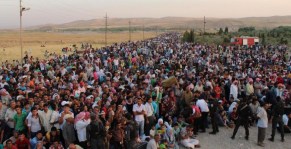 I thought about the refugees this morning when I read this passage. Our crowd. Many of us see one thing while Jesus sees another. The crowd is a crisis, a reason to fear, something to debate from a safe distance.
Weary, worn out, wandering people move the heart of Jesus. He is not afraid they will move in and take over. He’s not closing His borders to keep out the bad apples in disguise.
He sees a harvest of Gospel-ready people and feels compassion toward them. And far from telling His followers to “Be careful. Consider the implications. Keep yourselves and your land safe. Don’t get too close.”, He tells them to pray for people who will go to the harvest.
We know what it looks like. We know the risk. We know what could happen. But we are His people. His Church. We can trust that He sees what we can’t see. We can’t all go, but we can all pray for God to provide workers for this harvest. We can open our wallets and give the funds required to send them. We can stop choosing fear and start looking at how Jesus is responding to worn and weary people who have no shepherd.
And then do that.
[P.S. – I know many people who are going to engage the refugees with compassion. If you want to know how you can give to help them get there, contact me.]

 Some offenses are easy to forgive, while others are not. But forgiving someone does not depend on the size or impact of the offense, but on the willingness of our heart. Because forgiveness, like love, is a choice we make, not a feeling we feel. The key, for me, is in recognizing that forgiveness is not just an issue between me and the offender. There are spiritual eyes watching to see if an advantage will be given or not.
 “Now we want each of you to demonstrate the same diligence for the final realization of your hope,


 I didn’t see it at first, even though that one sentence seemed to stand alone on the page. I read it, and went on with my day, but my mind kept repeating the words. “…whose mother had been Uriah’s wife.” Why did He breathe those words? Why didn’t He call her by name? There were other women listed in the who-belonged-to-who section, why not hers? Her name was Bathsheba. Why didn’t He say it? It felt almost offensive, this dismissal of a woman.
 “Then the scribes and the Pharisees brought a woman caught in adultery,making her stand in the center.

 Karla Jo Wasion