top 3 list, but bottom line, read the bible. find God.

In my previous post I talked about the top 3 reasons Christians aren’t reading the Bible. This time, I’m giving my top 3 scriptural reasons why Christians need to read the Bible.

You have been created with purpose, and there are good works that have been planned for you to do.  You need a thorough equipping in order to live the life and do the work God has for you, and it will only be done through Scripture.

But how have many believers twisted this one? By assuming that it means that scripture is useful to us for teaching, rebuking, correcting and training OTHER PEOPLE. So when (if) they spend time in God’s word, it is for that purpose — to prove that others are wrong. I have seen the fallout from those who have used Scripture against other people while ignoring what it says about themselves. It turns people away from the Word of God, and even from the Church. It wounds the Body of Christ.

I want to speak particularly to mothers and fathers. Do not attempt to train your children with the Word of God unless you are allowing it to train you. Do not wield an authority that has not been tempered with humility. We are never more humbled than when we allow the Word of God to tell us we are wrong and then teach us how to be right. If you do not train your children up with humility, it will be done with pride. And pride hurts more than the prideful.

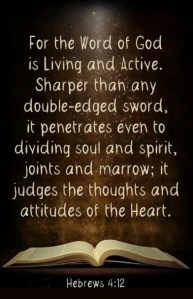
The Word of God, describing itself:  I am alive. I am active. I am sharp. I am penetrating. I divide. I judge.

We know ourselves enough to know there are things that need to change. Thoughts, attitudes, motives. But the trend I have been witnessing is the people of God devouring anything that will tell them they are okay the way they are. Those soothing blog posts that tell us that we need to love ourselves, accept ourselves and be our own champions sound like truth to ears begging for something sweet. Sermons and podcasts that convince us that our greatest mission is to go out, love others and share the Gospel. So we have an entire generation of people doing just that. Just that. Because we forgot to tell them that before Jesus commissioned His disciples, He taught them, and He revealed their own hearts to them. He allowed Peter to deny Him, because Peter needed to know that denial was in him. He revealed the motives of brothers who wanted the best seats. He called His closest followers out for their lack of faith on numerous occasions. We like to look at the stories in scripture and see that His disciples were ordinary people, just like us. That makes us feel better about ourselves. But we fail to see that they became extraordinary people because they had been with Jesus, the Word of God, night and day for three years straight. The disciples did not remain the same people they were before they began following Him. Neither should we.

Jesus is the Word of God. Then and now.

To those first followers, He was alive and active. Sharp. Dividing. Judging. Is He the same for His followers today? Yes. If we are in the Word of God, allowing it to do the work of piercing, dividing and revealing. If not, we are a people learning to love ourselves to death, sharing a Gospel we are not really experiencing.

How can we live a life of purity? How do we seek Him with all of our heart? How do we keep ourselves from sin? Every answer is the same.

The Word of God.

How are you living according to the Word of God, if you are not living in the Word of God? If you are living according to the Word of God, then you are living according to His will and His ways. If you are not living according to His will and His ways — then you are living according to someone else’s will and ways. I’ll give you one guess as to who that someone is.

Where did David hide God’s Word? In the place where sin begins.

But the things that come out of a person’s mouth come from the heart, and these defile them. For out of the heart come evil thoughts—murder, adultery, sexual immorality, theft, false testimony, slander.” {Matthew 15:18-19} 

He didn’t hide it in his mind. While knowing the Word of God begins with mental knowledge, it cannot remain there. It must make its way into our soul (mind, will and emotions), into our heart. My personal opinion? We can know the Word of God in our minds, but still not believe it or trust it. But when we meditate on it, choosing to let it go into our hearts and bring forth change, then we are in a place of not just knowing His Word, but trusting it to be true and right.

So let’s review my top 3 reasons that Christians need to read the Bible:

  1.  We need to be thoroughly equipped to live the life God has called us to live. And, we need to be taught, rebuked, corrected and trained by the Word of God. We just do.
  2. We need the piercing, dividing, revealing work of the Word. We have no idea the things that are in our own hearts. We need the Word of God to tell us that we have hidden motives, thoughts, and desires that are contrary to Him, and that it’s just not ok to stay that way.
  3. We need the Word of God to keep us from sin. Bottom line. That will not happen through sermons, or through a brief or sporadic glance at scriptures. It comes when we have lived in the Word of God until it is living in us.

Jesus found me in a hospital cafeteria, covered in sin. I found Him in the scriptures, covered in blood and grace and mercy and kindness and truth and glory.

My life, my character, my motives, my thoughts, my belief system — all changed when I was found by Jesus and surrendered to His lordship. That was the timing of it. But the method of it was by immersing myself in the living Word of God, and staying there.

Read your Bible. Find God.

why christians aren’t reading the bible

{Disclaimer:  Everything I’ve written below pertains to those who claim to follow Christ.}

After taking a poll, and from my own experience, the top 3 reasons Christians give for not reading the Bible are:

  • I don’t understand what I’m reading.
  • I don’t have time.
  • It’s not relevant to our culture today.

They seem like reasonable excuses reasons, and if they weren’t life-threatening, I would let it go. But they are. They are life-threatening little lies that have been sown by the enemy of your soul. And you are the Church, so I love you and scripture is food that you need to stay alive. I can’t just ignore the fact that you are starving yourself to death, so I really want to try to convince you to eat.

– I don’t understand the Bible. It’s confusing to me. 

To be honest, I would be concerned if the Bible were an easy read. It is a complex book, with layers of meaning on every page, authored by a mysterious and complex God.  So we will read for all of our days and never fully get it. But as mysterious as He is, He does not hide from us in His Word. For the first 4 years after I came to Jesus, I had zero knowledge of God, and a Bible I didn’t understand.  But I wanted to know God. I needed to know His heart for me, and I believed I would find it in that book. So I read and read and read until little by little, understanding started to form. I also asked God to help me comprehend what I was reading, and He did, a little at a time. Twenty-nine year later, I’m still reading, still asking. But I understand a whole lot more than I did twenty-nine years ago.

There is no question that God wants us to know Him, and to know and comprehend His Word. I think the question begging for an answer is this:

How important is it to you that you know and understand the Word of God?

– I don’t have time.

It feels that way for all of us, but those feelings are not true. We can get up earlier, watch less television, put down our phones, get off of our computers, spend less time wasting time, and we’d have a lot of time on our hands. The issue is priorities, not time.  If you felt your body starving, food would be a priority, no matter what you had to give up in order to eat. But you don’t feel your spirit starving. You think the weekly sermon, maybe a podcast during the week or that five-minute devotional you have with your coffee is sufficient. That’s like trying to keep your body alive by eating nothing but biscuits. You’ll get no argument from me that biscuits are a mighty fine piece of food, but you cannot live on them.

Discipline is part of the priorities issue. I have the same problem, only with actual food. It’s easier to grab a quick bite of processed food than to take the effort and time to make a healthy meal (that makes us me lazy, not pressed for time). For years and years, we don’t see what our undisciplined lifestyle is doing to us, and then one day we find ourselves in a battle in which we are on the losing end. So I’ll ask you what I’ve had to ask myself:

How important is it to you to be healthy? 

– It’s not relevant to my life today. 

Yes. The names and the places are foreign to us, as are the cultures in which the word was written. I’ll give you all of that. But honestly, the Bible is so much more than names and places and cultural settings. It’s about people who cannot seem to grasp how deeply they are loved by God, so they wander around looking for love in all the wrong places. It’s about people who struggle to trust a God they can’t see, in spite of everything He’s done for them. It’s the story of fearful, weary, prideful, broken, unfaithful, strong-willed, weak-willed, sinful people trying to figure things out.  It’s about people who want to do good but keep returning to the mud hole again and again.  It’s about love and hate and hurt and truth and lies and fear and bravery. It’s about slavery and freedom, and how we can go from one to the other. It’s about hope. And it’s about the God who is the author of that hope, the giver of life, the healer of the broken, the giver of mercy, and the Savior of all who will believe Him, including you.

How can that not be relevant to you?

In many places, the Church is starving herself, or at best, subsisting on the sugary coated sermons of eager to please pastors and/or feel good devotionals. There are far too many of the people of God who do not know the word of God, which means they are ill-equipped to battle the lies that are ruling in the earth. I’ve encountered so many believers who live in fear, anxiety, and insecurity, and those same believers do not know, or have a very limited knowledge of, scripture. Coincidence, or principle?

But it’s more than just knowing what the bible says. I am convinced, more than ever before, that if we are to be people who know God, trust God, love God, and who are equipped to stand firm in the coming days, we must be a people who have the Word of God in us, and who believe that it’s true!

In my next post, I’m going to talk about what the Word of God has to say about the Word of God, and why it is imperative that we make it a priority in our lives as followers of Christ. Stay tuned!


i need Jesus (my prayer for deeper)

“I need 2018 to be different.” That’s what I said to God in the last hours of 2017. I said it to Him because I know it’s pointless to say it to myself. With age comes experience and I have experienced enough broken promises to myself, so I’ve stopped making them. Promises. Resolutions. Whatever. They are paper-thin and fragile as a young girl’s heart. But. Prayer is a dog with different hair. (Is that how that goes? Doesn’t seem right, but I’ll leave it there for the time being.) Prayer is much stronger than promises and resolutions and determination to change.

Prayer only depends on me to speak and believe. It depends on God to be fulfilled, and God is the most trustworthy Being I know.

When I told Him I wanted 2018 to be different, the word “deeper” echoed in my heart. Different isn’t always something new, sometimes it’s just, well, deeper.

So, here are the top 3 deeper things I am praying for God to do in me in 2018:

  • A deeper commitment to my health. I no longer have the luxury of youth or pretending that eating whatever I want isn’t going to hurt me. It already has. The processed food/junk food/fast food/sugary food way of life I lived for so long has caught up to me and now I find myself having to race the clock to try to reverse stupidity. It’s harder than it sounds. But, I need something other than “I can’t eat this or that” to keep me going. I need to apologize to my body for the way I treated it all these years. This has to be about honoring the only body God has given me, not getting into a certain dress size. I will need endurance, patience, and commitment. I’ll need Jesus.

  • Deeper relationships. Deeper, not wider. To know and be known. To go beyond the shallows with people. I don’t want more friends, I just want to go deeper with the ones I have.  As a high introvert, it will be both challenging and refreshing. Challenging, because my preference is to be alone. Refreshing, because surface only relationships with shallow chit-chat are far too draining for me. But because I am who I am, I know it will require that I do some things I’d rather avoid (besides leaving my house, because I could remain indoors, like, forever). I will need to be vulnerable. Honest with how I’m feeling. And I’ll need to be willing to ask and be asked hard questions. If I want deeper relationships, then I will need to be willing to let someone else go deeper into my life. I’ll need humility and openness. I’ll need Jesus.

  • A deeper fasting and prayer life. I know the power of prayer and fasting. I don’t know why it has power, or exactly how it has power, I just know that it does. Mountains have moved in my life, I believe, as a result of prayer and fasting. But then, you know, stuff happens. Like the ever-increasing grip of a food addiction. And complacency. And possibly the lack of desperation. So I need the desperation that comes from needing Jesus, if that makes sense. I need the hunger and thirst that sends me into deeper places in search of His heart and His power to move another mountain.

I want to know God more. I want to know His presence and His power in greater measure than before. I want my heart to expand to hold more of His love, His compassion, and His mercy. I want to love and serve His people with deeper consistency. I want to return to my first Love and let lesser loves fall away this year.

So I can’t make resolutions or promises. Nothing as wispy and fragile as all that.

“For I know the plans I have for you, declares the Lord, plans for welfare and not for evil, to give you a future and a hope. Then you will call upon Me and come and pray to Me, and I will hear you. You will seek Me and find Me, when you seek Me with all your heart.” – Jeremiah 29:11

My resolution is a prayer because I need Jesus. And He promised I would find Him.

the f-word

aphiemi is our f-word. It means to send away, dismiss, set free.  It means to forgive.

So much has been said about forgiveness so I won’t go on and on. Probably. Maybe. We’ll see.

Here is what I have seen, what I am seeing, and what I myself have done:  searched the scriptures for a way out of forgiving someone, rather than for a way into it. Usually, our way out lies in a lack of repentance, or change, on the part of the person we need to forgive.  Most often the door out of forgiving is found in Luke 17:3-4.

“If your brother sins, rebuke him, and if he repents, forgive him. And if he sins against you seven times in a day, and comes back to you seven times, saying, ‘I repent,’ you must forgive him.” 

Ergo, if they don’t repent, we don’t have to forgive them. Two other places used as a way out of forgiveness are Colossians 3:13: “Just as the Lord has forgiven you, so you must also forgive.” and Ephesians 3:32 – “And be kind and compassionate to one another, forgiving one another, just as God also forgave you in Christ.”

God’s forgiveness comes at our repentance, so we use repentance, or change, as our measuring stick of whether or not we have to forgive someone. So let’s just talk about that.

What if, in Luke 17, the point Jesus was making was not repentance, but forgiveness? What if He was addressing the heart of the forgiver, not the forgiven? What if He was saying “I don’t care how many times he does the same thing to you and keeps coming back and saying “sorry”…you cannot withhold forgiveness.”

I mean, what if someone coming back over and over again and repenting for the same sin isn’t really the definition of repentance, and therefore, repentance is not the criteria for forgiving someone seventy times seven?

So let’s throw Colossians and Ephesians up and see what sticks.

“Just as”. That’s what usually sticks. And so then we say God forgave us when we repented, so just as He did, we are to do. Ok, fair enough. Let’s talk about that.

What if we have no ability to offer anyone salvation and therefore, our forgiveness cannot be based on repentance? What if by “just as”, He was referring to any number of other things besides “when they repent”?

Like, completely. Fully. Unmerited. Forgiveness given when it is not even close to being deserved. Because that is how God has forgiven us in Christ, and it should make us out of our minds grateful. Not searching for a way not to give that same thing to others.

What if God was saying to us, “I so desired to forgive you that I sent my Son to die to make it happen”. What if forgiving as God forgave means looking for a way to forgive, rather than for a way not to forgive?

Well, what about repentance? What about it? First of all, those of us who are looking for a reason not to forgive, aren’t really looking for repentance. We want change. We are demanding to see the fruit of repentance before we forgive. Which is not the way that God has forgiven us. Not if we believe the gospel. What we really have to ask ourselves is not “did they repent”, but “what do we do with these scriptures”:

But if you don’t forgive people, your Father will not forgive your wrongdoing. – Matthew 6:15

And whenever you stand praying, if you have anything against anyone, forgive him, so that your Father in heaven will also forgive you your wrongdoing. – Mark 11:25

Shouldn’t those statements have us scrambling to find a way to forgive the people who have hurt us, rather than trying to find justification not to forgive them?

I know what it feels like to have to forgive someone who has done you great harm, and not owned up to it. I know how hard that is and how gut-wrenching the work of forgiveness can be.  I know that it feels like forgiveness is the same as saying they didn’t do what they did, or that what they did doesn’t matter. It feels like they are getting away with something. It feels unjust.

This has become one of the deepest truths I know:  forgiveness is a choice, not a feeling. If you are waiting to feel forgiving, stop it.  We have to stop trying to figure out what forgiveness feels like, and see what it looks like. Below is an excerpt from my book on the restoration of my marriage (the book is still in process):

It looks like never mentioning any of it ever again. No matter how mad I am. No matter how hurt I am. No matter how much I want to get back at him. I choose to let forgiven things remain forgiven.

It looks like not allowing my thoughts to turn over the rocks of the past, digging up the dirt of things buried in my forgiveness. In other words, I don’t think about the things I’ve forgiven. I just don’t. If those thoughts come in, I send them right back out. I choose to think of something else. I choose to start speaking Scripture about what is true about my husband. I choose to keep forgiving.

It looks like allowing my scars to be evidence of God’s healing instead of evidence of my wounding. Those scars didn’t all come from my husband. I had to forgive the person who molested me, the ex-husband who abused me, and [many others who have hurt me deeply throughout my life].

Forgiveness in my story looks like refusing to protect my own heart from pain. It’s staying vulnerable. It looks like trusting God.

It looks like remembering how very much I have been forgiven. It’s recognizing that what was done and what was said during those years were from a place of brokenness, and broken people do broken things and we are all broken at some point. You. Me. All of us have hurt people we love. Then we pull out our scales of justice and measure how much pain we’ve inflicted against how much pain we’ve been dealt and somehow, the scale always tips in our favor. I choose to throw away the scales of what justice looks like to me, because it is mercy and forgiveness I’ve been given by God, not justice.

If you are struggling with the f-word, then do what you know to do. Repent. Turn around. Go the other way. Look for a way into forgiveness instead of a way out of it.

I promised not to go on and on. Promise broken. Forgive me.

i can live with that – part two

That question. The observation of God designed to bring to the light what needed to be exposed.

What are you co-existing with that you should have driven out?

If you missed Part One of my journey with this question, you can read that here.

It’s easy to co-exist with something when you don’t know it is killing you. When you don’t recognize it as an enemy, it will go unnoticed, be seen as harmless. Until you discover it isn’t. Until God begins to shed light on what the enemy has been doing. Here are a few of my own observations — some from my own story, some not.

It is the enemy of peace. The enemy of boldness. The enemy of trust. But we’ve learned to live with it. We’ve figured out how to manage fearful living. We settle for moments of peace rather than hearts that carry peace. We’ve learned to calculate risks and then call ourselves risk-takers when we’ve taken a few small steps of courage into something unknown.

But we are told to count the cost (risk) of following Jesus before we commit to follow Him, not after.

For those who are in Christ, nothing is a risk anymore. Unless we have chosen to co-exist with fear.

But I think the worst part of learning to live with fear is that we live life primarily in the realm of what is possible. Because fear can barely believe for the possible, believing for the impossible is out of the question. It keeps us bound to what we can control and refuses to allow us to let go and be at peace with what we cannot control. And we’ve settled for that, rather than doing the work to banish fear from our land. We’ve settled for mostly medicating fear so that we can manage it, instead of refusing to allow it to live with us.

The enemy of spiritual growth. We can certainly grow in knowledge while being full of pride, but we will not grow in character because that requires humility. Pride will also either destroy or at least cripple, our earthly relationships. Let’s be honest, most of us, including the prideful among us, are repelled by prideful people.  Pride feeds on comparison. It keeps us constantly comparing ourselves to others, and then adjusting our lives according to what we see. We either take on arrogance, having determined that we are better than others, or we take on shame and defeat, believing we have fallen short. Either way…it is all about us rather than about Jesus. Pride is destructive to every inch of our land and keeps us in what has to be one of the most tormenting of bondages:  the bondage to self.

But perhaps most devasting is that pride is the enemy of humility, which makes it the enemy of the nearness of God, because God resists the proud, but draws near to the humble.

Pride will keep God off of our land. 


Apathy & Complacency

Apathy is a lack of enthusiasm, interest or concern. It lulls us to sleep. It convinces us that spiritual zeal is wacky, out there, and over the top. It allows us to attend church on Sunday, check off that box, and then go back to real life. Apathy keeps us nice and full on the things of this world so that we experience no hunger for the things of God.

Complacency is Apathy’s sibling. It is a smug satisfaction with ourselves or our achievements. It keeps us comfortable right where we are, with no motivation to change.  At the core, they are enemies of our relationship with Jesus. Both apathy and complacency allow us to have a comfortable, un-demanding, effortless Christianity, regardless of the fact that it is a life that cannot be found in scripture. Except in one place.

The Amen, the faithful and true Witness, the Originator of God’s creation says:  I know your works, that you are neither cold nor hot. I wish that you were cold or hot. So, because you are lukewarm, and neither hot nor cold, I am going to vomit you out of My mouth. Revelation 3:14-16

Far too many Christians have chosen to live their lives in the lukewarm waters of apathy and complacency, thinking everything is just fine. It is not. We are living with the enemy of our soul.

And then, there was more.

All bitterness, anger and wrath, shouting and slander must be removed from you, along with all malice. – Ephesians 4:31

All anger. All wrath. Know the difference between those two?

[wrath] indicates a more agitated condition of the feelings, an outburst of wrath from inward indignation, while anger suggests a more settled or abiding condition of mind, frequently with a view to taking revenge. [Anger] is less sudden in its rise than [wrath], but more lasting in its nature. [Wrath] expresses more the inward feeling, [anger] the more active emotion. (Vine’s Expository Dictionary of New Testament Words)

Don’t miss this part:  anger suggests a more settled or abiding condition of mind

Anger is a mindset. 

Have you ever known someone who just seems angry all the time? Is that someone a parent? A spouse? A boss? If so, then you know the destruction that anger brings to relationships. To unity. To intimacy. To love and affection in the family. Anger keeps people on eggshells around you. It also forces them to keep a distance, if not physically then at least emotionally.

Oh, but get this.

 When Israel became stronger, they made the Canaanites serve as forced labor but never drove them out completely. — Judges 1:28 

Sometimes it is the thing that we believe is serving us that is the very thing we are supposed to get rid of.

My story includes deep anger. Anger that served me well because it protected me from emotional pain. So trust me when I say that I know how hard it is live without something that has served you. I can also attest to the fact that it was killing me and had a part in killing my marriage. I just didn’t know that when I allowed it to co-exist with me.

I didn’t know that my servant was my enemy.

But wait. There’s more.

So rid yourselves of all malice, all deceit, hypocrisy, envy, and all slander. – 1Peter 2:1

Of all of these, the one that stands out the most, the one with which many choose to co-exist?

Pretense. Play-acting. Mask wearing. {Hypocrite is the Greek word for an actor in a play.}

We show the parts of ourselves and our lives we want others to see, and we hide the rest. We put on a show, making others believe that we have it all together, we’re happy, we’re successful, we’re religious, we’re — whatever it is we want them to think of us. But we put a mask over our insecurities, our sadness, our depression, our debt, our jealousies and our dwindling faith.

Hypocrisy becomes a way of life, as though we are always on stage. It destroys our ability to be real with anyone, including those closest to us. It is the enemy of transparency, the enemy of true relationship. It is the enemy of one of our most fundamental emotional needs — to be known and accepted. And while I cannot prove it, I believe that where we find hypocrisy, we find pride and we find fear, all huddled together.

I’m going to go ahead and stop here with this little morsel:

“I brought you out of Egypt and led you into the land I had promised to your fathers. I also said: I will never break My covenant with you.  You are not to make a covenant with the people who are living in this land, and you are to tear down their altars. But you have not obeyed Me. What is this you have done?  Therefore, I now say: I will not drive out these people before you. They will be thorns in your sides, and their gods will be a trap for you.” – Judges 2:1-3

God doesn’t play. This wasn’t about His rejection of them (or our loss of salvation), it was about his discipline for their disobedience (and ours). Yes, we live under grace, but the New Testament also teaches us that God disciplines those He loves (Hebrews 12:6), so grace is not absent discipline. We cannot wave this off as either optional or as something we don’t need to bother with — not anymore.

There is too much happening around us. Darkness is getting thick, my friend. We cannot afford to let our light be diminished by our own disobedience.

This has been my journey with God lately. Getting a good look at what is on my land that I need to drive out. Staring my own disobedience in the eye.

Now I’m seeking God’s help to know how to stop co-existing and start driving out. I’ll keep you posted. If you’ve already been down this road, help a sista out. Offer up your wisdom. And if you’re in the thick of it, let me know how it’s going. Getting rid of things is hard work. I’d love to pray for you as we journey this part of the road together.

i can live with that – part one


At the same time the Benjaminites did not drive out the Jebusites who were living in Jerusalem. The Jebusites have lived among the Benjaminites in Jerusalem to this day. {Judges 1:21}

I could go on about how I was in the book of Judges with no idea why I chose to go there. How I was reading along at more of a yada yada pace than taking a contemplative stroll. I could tell you about reading past verse 21, but not really because my eyes kept going back to it even though my brain kept wanting to move on. Get to something interesting. I could tell you all of that, but I won’t. I’ll just cut to the chase. Or to the quick. Whichever it happens to be for you.

What are you co-existing with that you should have driven out?

Personally, I needed a whole minute after that question. Could have been a month. A month of trying not to let it stop at conviction. Forcing myself to stay with it and not push it away as one of those oh, that’s good moments and then go back to being whatever it is that I am. Oblivious. Comfortable. Unconvicted.

I may need more time. But here is where I share my journey with whoever may be listening, so I’ll share a couple of miles or so I’ve gone with this so far.

The Israelites had been told to drive out the inhabitants that were in their promised land. Get rid of them. The promised land was the territory God had given them. Places He had given them the authority to dwell as His people.

What is the spiritual shadow being cast by this physical reality? What is my land, my territory of authority?

My home, family. My marriage. If I were still raising children, my parenting would be a place God has given to me, but now it’s my grandparenting.  Ministry. Calling. Gifting. My workplace. My relationships with God, and with others, inside and outside of the Church.

This is my land, my territory. God has planted me here and given me authority, spiritually.  These are the areas I have felt led to ask myself the question — what have I been allowing to co-exist with me here, rather than driving it out?

Some that I came up with apply to me, and some do not. Maybe they resonate with you, though.

Fear, including the fear of man. The fear of disappointing someone, of feeling their disapproval or criticism. That kind of fear will keep us in a place of striving, trying to please and appease. It will keep us from speaking the truth when truth needs to be spoken. Then there is the fear that comes when we watch the news. That’s the fear that can turn our desire to be informed into an obsession. And because we are obsessed with what is going on around us, we are continually fueling fresh fear.  And no, the answer is not to bury our heads, no longer paying any attention to the news. The news is not the trespasser on our land. Fear is.

{Also, for the record — fear includes control, because control is rooted primarily in fear.  Think about it.}

Pride, which includes a low self-esteem. Whether thinking too much of ourselves, or too little of ourselves — we are still continually thinking of self. Narcissism, which is pride on steroids, is rampant in the Church. One day on social media will confirm that, I promise.  Comparison is also rampant and is rooted in pride. Self-hatred, self-loathing, self-everything — all the offspring of pride.

Pride ensures that no matter where we look, we see ourselves.

{It also includes a judgmental and/or critical spirit, both of which can be traced back to pride.}

Apathy/Complacency. Couch surfing Christians. Those who believe they follow Jesus, but never actually follow Him past the couch. They keep their religion as a “private” matter, never talking about it with others.  Or, they post spiritual memes on their social media accounts and consider that sharing the gospel. It is spiritual laziness and we have made peace with it and allowed it to co-exist with us in every aspect of our lives.

I can think of others, can you? A religious spirit, unbelief, addictions of every kind, and compromise, just to name a few.

To figure out how and why these things are enemies that should not be allowed to co-exist with us, we have to consider what they destroy, or at a minimum, what they hinder in us. We’ll do that in the next mile. Stay tuned!

we’ve got better things to talk about

The shift has been subtle. My view slowly changing, steps receding, pupils dilating to take in more light, see bigger. I think God is doing something, but it’s like having a mouth full of meat. I keep chewing and chewing, trying to taste and talk at the same time. So for the next few moments, just ignore the sound of me trying to swallow something that is too big for me.

The headlines should be enough. They tell me all I need to know, but then there’s the ‘click’ as I go in to get all the details. Because we all have our magnifying glass in our hands, like children on the ground trying to see the smallest parts of our world. So we move in on the stories of horror and grief and mankind slipping further and further into an abyss of madness, and we try to pretend we are staying informed but not affected. Like traipsing through the muck of our current culture and having incessant discussions about the latest acceptable deviance isn’t doing anything to our hearts.

(But it is, you know.)

And I see God’s people sifting through the garbage dump. Horrified by what we see, but unwilling to look away. Pointing and announcing how unacceptable the garbage is, as though the rest of us need to be convinced. Sometimes it feels like the only thing we talk about is how dark the darkness is becoming. And how the darkness doesn’t line up with God’s word.

(as though it used to but now, oh the terrible times we live in now)

But I feel the shifting, don’t you? God calling His people to look up. To set our eyes on Him. To remember. To stop trying to convince the garbage dump that it is full of both garbage and the disapproval of God. To stop trying to convince the world that God is on our side and not theirs.

(as though God so loved us and not the world)

Let’s get off the ground. Stop examining the dirt. Look up and get some perspective.

Evil exists. Depravity abounds. People are doing things and believing things that are ungodly. We can stop looking so surprised and appalled. And afraid.

(we have nothing to fear. nothing.)

I don’t want to be filled with righteous indignation because some man is demanding the right to be a woman. There’s nothing wrong with being aware of what’s going on, but I don’t need to give it the attention it wants.  It’s a conversation for my prayer closet, not a threat to my faith, or to the Church.

{And I tell you, you are Peter, and on this rock I will build my church, and the gates of hell shall not prevail against it.} Matthew 16:18

I want to be filled with wonder as I watch God pursue the heart of my co-worker. I want to be giddy over what He is doing through local ministries bringing His hope to the broken. I want to shout for joy because He is answering prayers for family and friends. I want harvest parties when hard sowing bears beautiful fruit. I want to go deep into the stories of how God is loving people, showing mercy, rescuing sinners and making them saints.

I feel Him tugging. Gently urging us to our feet, from peering at the dirt as though dirt is something new.

Anyone can look at a garbage dump and talk about the garbage. But we are the children of God. We recognize Him when others cannot. We know what it looks like when He is moving. We know His handprint when we see it. We are the ones who know Him, know that He is moving in the earth, healing, delivering, saving. We have the spiritual eyes to see Him pursuing people, drawing them to turn around and follow Him. We are those who know that God is showing love to the least and compassion to the hurting. Remaining faithful and not walking away when it gets messy and hard.

We know He is not shouting at the garbage, but reaching in and pulling people out of it. One at a time. Drawing them with His kindness, not His wrath.

We are the only ones who can see what our Father is doing, and do it with Him.